In August 2024, I headed out to what the Oroville, CA locals call “The Rockpiles”. It is a portion of the 11,800 acre Oroville Wildlife Area (California DWR) that lies on the western side of the Feather River. This particular area gets its nickname from extensive dredging for gold between 1898 and 1952. The process of bucket-line dredging created many channeled ponds, with deep piles of tailings on both sides. The piles only contain what I consider “larger”, rounded river rocks in countless colors, and various types and components. The smaller sand and gravel was removed in the 60’s for use constructing the Oroville Dam; about 10 miles northeast. Below are some images of the area.
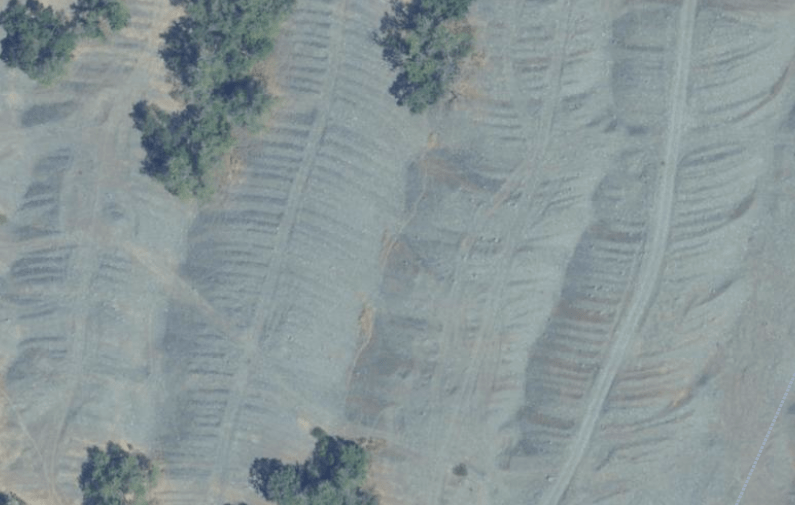

In the deep dredge tailings in the Oroville Wildlife Area, east of Biggs, CA; a massive deposit of the heavier rounded river rocks from 3/8” to basketball sized plethora of rock types. These were stripped from the Sierras as the flood cut the Feather River Canyon, and dropped from the flow as the flat land slowed and spread out the water volume. Going back to gold deposits, the stripping of the mountains explains the richness of the California gold deposits. I started collecting rocks that i thought might contain beautiful, interesting, or valuable things inside. I took home about 100 rocks the first time. Most were smooth, rounded, and of various composition. Inclusions, and colors. A few started to stand out in the mix strongly. They were coated in a layer of clay, in varying thickness, texture, size and shape. The first one I saw had a reddish tint to the clay. Its dimensions were about 8 inches long, and about 5-6 inches wide at the larger end. It was shaped similarly to an egg, and the thickness was similar to that egg being smashed into half its thickness. I picked it up, and rather than it being light as expected, it had substantial weight to it; pointing to a possible dense core. The clay coating was pockmarked, dry, and flaked off easily. I scanned through thousands more rocks, and saw another rock coated with clay. This one was different. It had haft to it like the last, but the clay was solid, a tan color, but it was mottled with black. As if it had been cooked/burned. It was 1/3 smaller than the last. Egg shaped, but exactly like a full egg (thicker). The next one I found 2-3 feet away. It was a grayish-tan color, pockmarked, had moss growing on parts of it. I expected that heft, but this one was really light. I surmised it would likely be similar outside and in. As more caught my eye, I started to discern the multiple characteristics and composition of what I felt like had to be the same or similar rock type. I started looking for the flattened egg shape, and found more blackened, baked, hard, dense rocks with reddish, whitish, and blue hues. I found more with dry, easily crumbled clay. I began to locate what seemed to be the same rock, but with no clay. Most still were pockmarked on the outer, hard rock shell. When I got home, I started to cut the rocks in half with a 7” diamond blade wielding, Rigid, table mounted, water cooled tile saw. The first happened to be one of the light ones. As expected, clay all the way through. Huh. The second was the first rock of that type I picked up. The reddish clay softened immediately when hit with water. When the saw hit about 1 in deep, the pitch increased, and the rotation slowed. When it fell in half, I was thrilled to find the clay formed about an inch-thick rind around an ellipse of dark, emerald green glass, with white and black specks, and yellowish veins streaking randomly. I was flabbergasted after cutting through about half of what I had surmised seemed to be either a similar or consistent rock type; and my theory seemed to be proven correct-MAYBE… I had two Geology classes in college, and as an avid outdoorsman, fisherman, and hunter; I was somewhat familiar with most of the rock types in my area. The Rockpiles contain thousands of varieties of rock type and mineral composition. Whatever this was, had an amazing range of variation, yet obvious similarities in composition, hardness; rind thickness, texture, density, and existence. The cores varied from homogenous clay, to containing random colors, shapes, and sizes of metamorphically changed areas. The variance of rind thickness was broad, and seemed to coincide with the density, clarity, and transparency of the glassy core. The soft-coated might have nothing Changed inside, small specks of “cooked” glass, or a circular or elliptical solid core. The ones with a hardened, blackened, thin rind could be yellow, red, purple, a shade of green from mint chip ice cream; to so dark green, it looks black. The stripped, roughly textured examples had similar variants inside. The heaviest, densest, and with an extremely thin, extremely hard rind; proved to be mostly dark green, with black, white, or teal inclusions. These tend to be translucent. With my newfound rock hobby, and the theory that this virtually indestructible, beautiful, gem-like interior could be valuable; I joined the local rock club! Ironically, the clubhouse is two minutes from my house, and on the way to the Rockpiles. Two older, knowledgeable members said I had Nephrite Jade. The word Jade certainly piqued my interest. Finally, my naturally inquisitive mind, and my desire to understand the complexities and wonders of Mother Nature and her Creator; formulated an obvious question. If the mainstream geological model was correct, I had to ask why ANY of these rocks were encased in CLAY, let alone the existence of what are essentially balls of soft, vulnerable clay. If the Feather River had been scooping these up from their source (likely in the lower half of the Canyon where Serpentine is abundant), and slowly battered, chafed, and rolled for what I estimate to be 40 plus miles; over thousands/ tens of thousands/or millions of years, there should not be a speck of clay left clinging to a single rock. Then, I remembered that a cast-iron dredge bucket line stripped them up from their resting place, and run through a steel trommel, while being blasted with water. They get spit out the end of a conveyor belt, and they have sat there through about 50 years of our hard-swinging weather. I’m more likely to subscribe to become a Flat-Earther than believe that is possible. The only scenario I can envision, is what my discovery will help to show the scientific community, is the truth of what occurred. The thing about the Younger Dryas Impact Hypothesis that I cannot reconcile, is it does not help to explain the creation and dispersion of my rocks. In fact, since it subscribes to an “old Earth” geologic model, it falls short in other areas I see.
The only cause of the cataclysmic flood that explains every aspect of evidence scientists find, is that GOD did it! Most would know it as Noah’s Flood. I have the YDIH to thank for giving me the spark to research this flood from every angle; and finally see what really happened. Before this, I fully supported the YDIH, and the Biblical flood was difficult for me to believe. Once you see what I have compiled, you may agree with me; or maybe not.
 Younger Dryas Impact Hypothesis Research