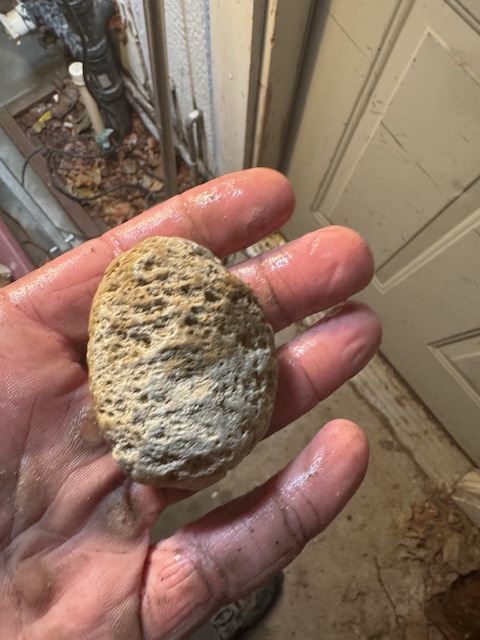
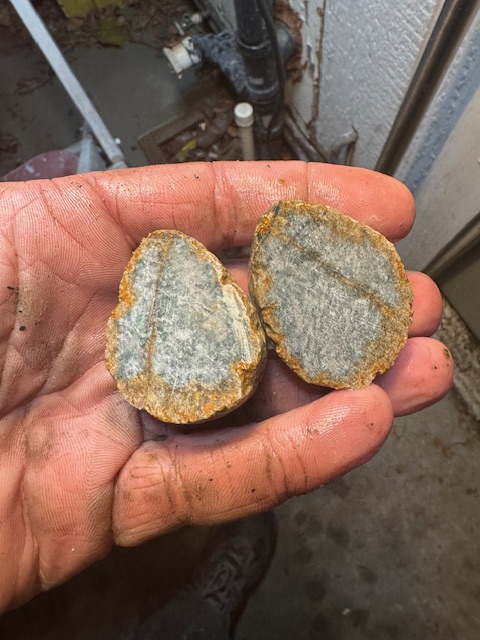
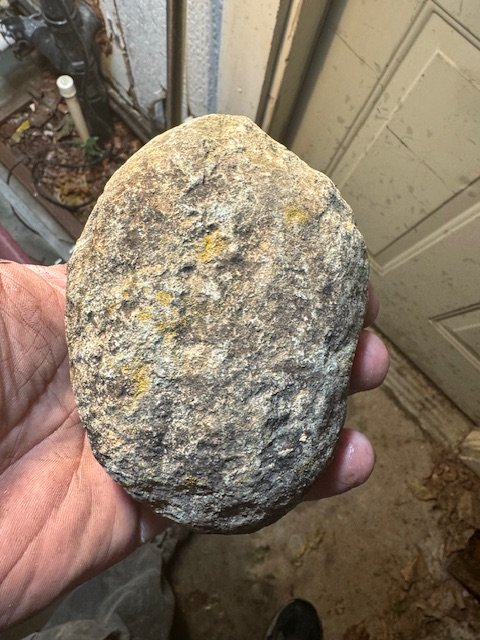
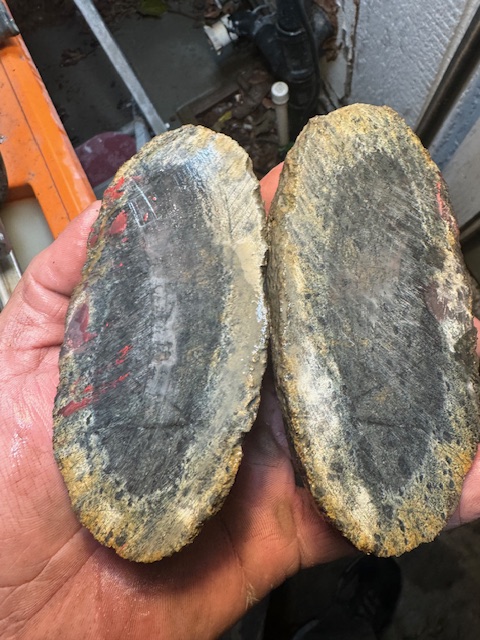
The consistency of my findings shows that these unique clay-rind, green-core nodules could not have formed, survived, and been deposited through slow, ordinary processes. Their fragile coatings remain intact despite being dredged, tumbled, and exposed for decades — something impossible if they had been transported gradually over thousands or millions of years. The only viable explanation is that they were created, altered, and deposited in a very short window of time under catastrophic conditions.
The sheer variety of textures and cores, yet the repeated overall form, points to a common origin event. For them to exist in such abundance, clustered together within the Oroville flood gravels, they must have been produced geologically “all at once” and immediately swept into transport by waters of immense volume and power. This scenario is best explained not by slow geologic time, but by the sudden onset of a world-reshaping deluge. In this sense, the evidence aligns most clearly with the description of the Biblical Flood — a cataclysm that both created and delivered these rocks into the valley in a short chain of epochal events.
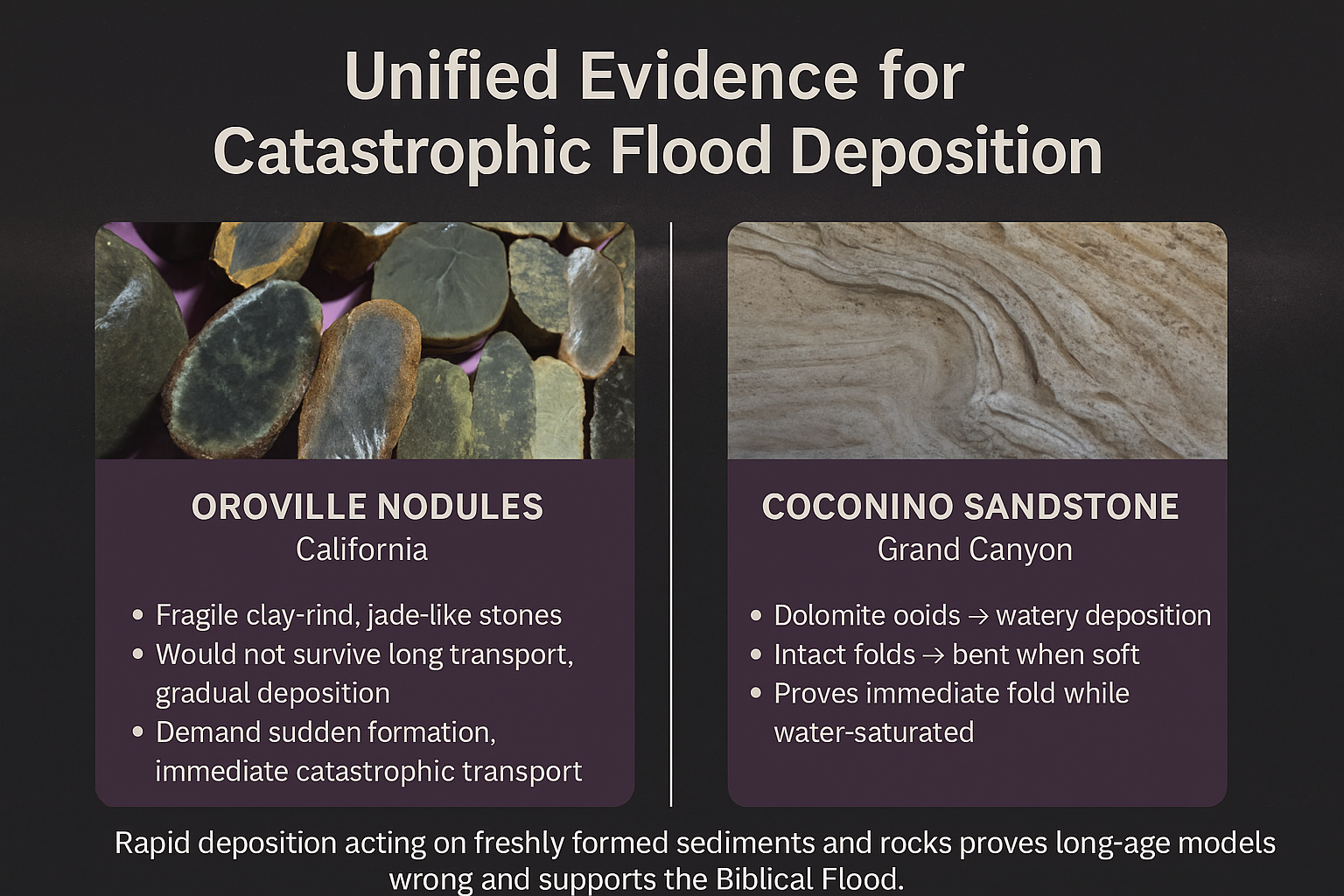
Unified Evidence for Catastrophic Flood Deposition
Both my field discovery in Oroville and the published findings of Dr. Andrew Snelling and Dr. John Whitmore in the Grand Canyon point to the same conclusion: Earth’s rocks and sediments were deposited rapidly during catastrophic flooding, not slowly over millions of years.
- Oroville Nodules (California): The fragile clay-rind, jade-like stones I collected in the Oroville Wildlife Area could not have survived long transport or exposure if they had been moved gradually. Their survival, variety, and concentrated deposition alongside gold-rich gravels demand a scenario of sudden formation and immediate catastrophic transport.
- Coconino Sandstone (Grand Canyon): Snelling and Whitmore’s research revealed dolomite ooids in the sandstone — evidence of watery deposition, not desert dunes — and intact folds where the entire sandstone layer bent without cracking. These folds prove the sandstone was still soft and water-saturated when bent, not hardened over millions of years.
Taken together, these cases reinforce the same principle: catastrophic flood action, acting on freshly formed sediments and rocks, explains features that long-age models cannot account for. Both the Oroville specimens and the Grand Canyon sandstone bear witness to rapid deposition, immediate folding or transport, and preservation under flood conditions. This unified line of evidence strengthens the case that the true framework for Earth’s geology is not “deep time” but the single, world-altering event described in the Biblical Flood.
Coconino Sandstone: Conventional vs. Flood Model
Conventional View:
- The Coconino Sandstone (hundreds of feet thick, covering ~200,000 square miles) is interpreted as ancient desert dunes deposited ~275 million years ago.
- Supposed evidence: large cross-bedding (angled layers) similar to modern sand dunes in deserts.
Problems with the Conventional View:
- Dolomite Ooids
- Snelling and Whitmore found rounded dolomite grains (ooids) within the Coconino.
- Ooids form in shallow marine water with strong wave agitation, not in dry deserts.
- Their presence is fundamentally inconsistent with a dune environment, but perfectly consistent with a water-laid deposit.
- Soft-Sediment Folding
- In at least three major folds of the Coconino, the sandstone bends smoothly without cracking or faulting.
- If the sandstone had been lithified (turned to stone) for millions of years, it would have fractured under folding.
- The intact folds prove the sandstone was still soft, water-saturated, and unconsolidated when bent — meaning the folding occurred soon after deposition, not long ages later.
- Trackways & Fossils
- Fossilized trackways of vertebrates and invertebrates have been found within the Coconino.
- Many tracks show claw-drag marks, consistent with animals struggling under water currents, not walking freely on dry sand dunes.
- The trackways support deposition in wet, watery conditions.
Implications for the Flood Model
Its rapid deposition, followed almost immediately by tectonic folding while still soft, is best explained by the Biblical Flood model.
The Coconino is part of a massive sequence of “flat-lying” layers in the Grand Canyon, stacked one atop another, many extending across North America.
The evidence of water-deposited grains, soft-sediment folding, and animal trackways under water all point toward rapid, catastrophic processes.
Rather than millions of years of desert dunes, the Coconino Sandstone was laid down quickly by floodwaters sweeping across the continent.
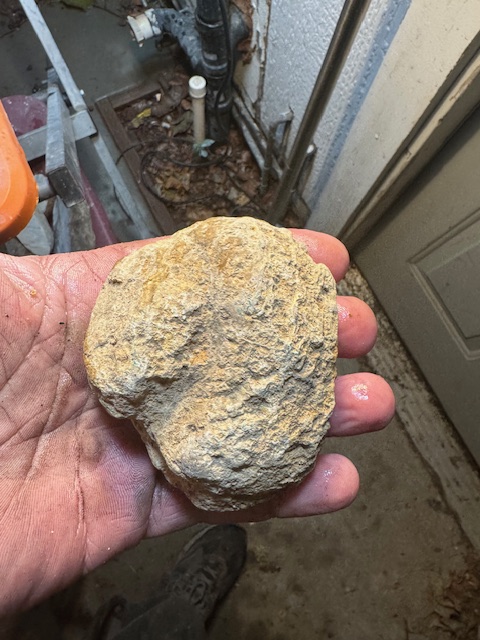
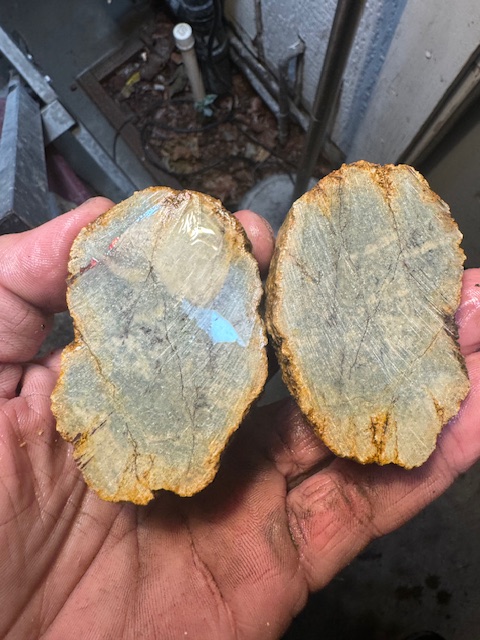
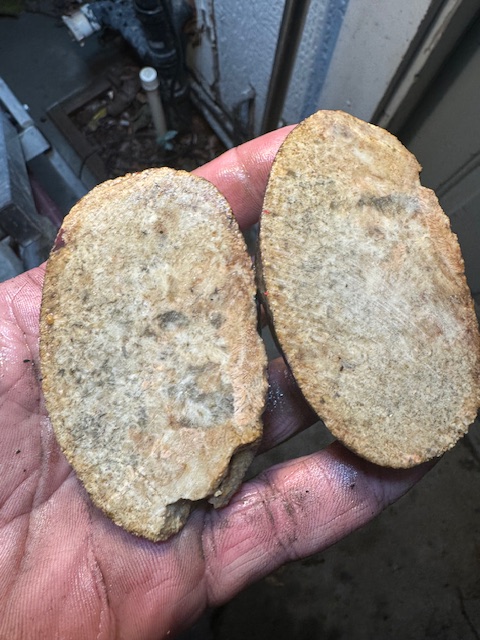
Photos and Videos of my work.

 Younger Dryas Impact Hypothesis Research